

Trane MTA TAEevo TECH process chillers are designed with built-in safeguards to protect both the equipment and your operation. One of the ways the system does this is through its alarm monitoring features.
If you hear an alarm tone from the controller, you will also see a code displayed on the chiller screen. These alarm codes help identify which part of the system needs attention so that issues can be addressed quickly and safely.
In this article, we’ll review several common process chiller alarm codes, what they mean, possible causes, and recommended next steps. While alarms are part of the chiller’s protective design, our service team is always available to help you evaluate and resolve any condition that arises.
Locating the Alarm Reference Diagram
On the chiller’s front panel, you’ll find a diagram of the refrigeration loop. This diagram highlights several common alarm codes and visually indicates where in the refrigeration circuit the condition is occurring.
For chillers with two refrigeration circuits, alarm codes will include a “1” or “2” to identify which circuit is affected (for example, b1AC or b2AC). Single-circuit chillers will not display alarms containing a “2.”
Below is an overview of the most common alarms, along with one additional code that may appear during startup.
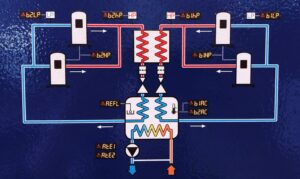
This diagram is for a two circuit chiller
AEFL – Low Tank Level Alarm
This alarm indicates that the water tank level has dropped below the acceptable threshold.
Possible Causes:
- Leak in the water circuit
- Air present in the water circuit during startup
Next Steps:
- Refill the tank with water or the appropriate water/glycol mixture as specified for your system
The chiller will not allow this alarm to be reset until the tank has been refilled to the appropriate level.
This safeguard helps protect the pump and ensures proper circulation through the system.
b1AC & b2AC – Anti-Freeze Alarm
This alarm indicates that the water temperature leaving the evaporator is approaching or below the freeze set point.
Possible Causes:
- Water circuit temperature leaving the evaporator is below the freezing set point
- Low water flow through the evaporator
- Freeze set point not properly adjusted for glycol percentage at startup
Next Steps:
- Check the chiller’s flow rate
- Verify that the appropriate glycol percentage is being used
The chiller will not allow this alarm to be reset until the freeze alarm set point is 10°F higher than the chiller’s operating set point.
This protective feature helps prevent evaporator damage due to freezing conditions.
AtE1 & AtE2 – Pump Current Overload
This alarm indicates that the pump motor current has exceeded safe operating limits.
Possible Causes:
- Pump motor failure
- Chiller water outlet pressure too low at startup
Next Steps:
- If occurring at startup, throttle the outlet flow
The chiller will not allow this alarm to be reset without resetting the pump circuit breaker (KP1 or KP2 on the electrical schematic).
Because the pump is critical to system operation, this alarm ensures that electrical and mechanical components remain protected.
b1HP & b2HP – High Refrigerant Condensing Pressure
This alarm indicates elevated refrigerant condensing pressure.
Possible Causes:
- Fan failure
- High ambient air temperature
- Condenser air inlet filters blocked by debris
- Recirculation of hot air from outlet to inlet (often during startup)
Next Steps:
- If the fan is operating, remove the condenser air filter panels and clean with water to remove dust and debris before reinstalling
This alarm can be reset once the pressure returns to the normal operating range.
Maintaining proper airflow around the condenser is important for consistent performance.
b1LP & b2LP – Low Refrigerant Suction Pressure
This alarm indicates that refrigerant suction pressure has dropped below acceptable levels.
Possible Causes:
- Refrigerant leak
- Expansion valve failure
Next Steps:
- Contact our service team for support
Because refrigerant-related conditions require specialized tools and expertise, our technicians can safely diagnose and resolve the issue.
ALc1 – Phase Alarm
This alarm indicates a power supply issue.
Possible Causes:
- Fluctuation in power supply
- Phase loss
- Incorrect wiring during startup
Next Steps:
- Interchange two phases of power
The chiller will not allow this alarm to be reset until power is restored to all phases.
Stable electrical supply is essential for reliable operation, and this alarm helps prevent damage from phase imbalance.
When an Alarm Appears, We’re Here to Help
Alarm codes are part of the TAEevo TECH chiller’s proactive design. They are intended to alert operators early, helping prevent more significant issues and protect your equipment.
If your chiller displays an alarm, the best next step is to contact our service team. In many cases, we can help assess the situation quickly—whether that means guiding you through initial checks over the phone or connecting you with your local Trane service team.
If you are experiencing an alarm condition, please contact our service team at (716) 693-8651 or mta_usa_service@tranetechnologies.com. We’re here to help you navigate the situation and restore normal operation with confidence.
Reliable process cooling depends not just on equipment, but on the support behind it.